This is an archive site for The Environment Report. From 1995 to 2010, the news service produced environmental news features and spots for radio stations around the Midwest – Great Lakes region and around the country.
There’s nearly 20 years’ worth of in-depth reporting on the environment in our archives, and you can continue to access by using the search button on the top right.
Two of the guys behind SkySpecs, Tom Brady (l) and Ryan Moore (r), explain their autonomous flying robot. (Photo by Joseph Xu, Michigan Engineering Communications & Marketing)
Wayne State University student Tom Kim makes a pitch for his LED lightbulb. It's made with vegetable glycerin. (Photo by Joseph Xu, Michigan Engineering Communications & Marketing)
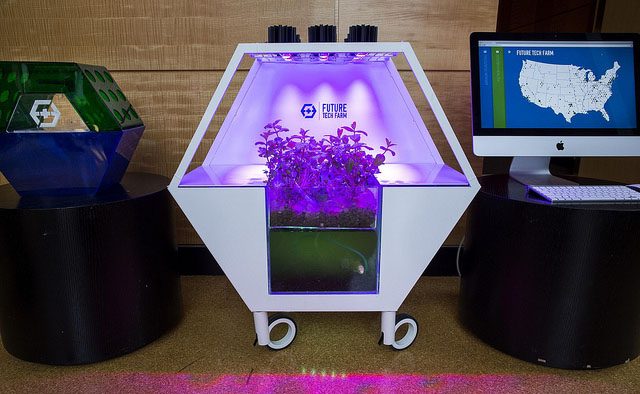
Future Tech Farm, the invention of Brian Faulther and Austin Lawrence from Kettering University. (Photo by Joseph Xu, Michigan Engineering Communications & Marketing)
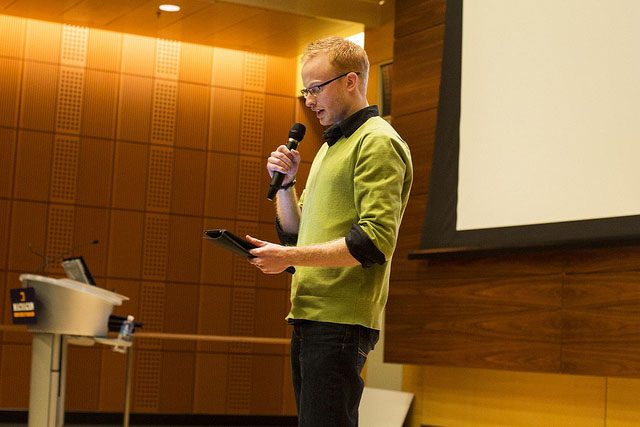
Brian Falther makes a pitch for Future Tech Farm. (Photo by Joseph Xu, Michigan Engineering Communications & Marketing)
Keith Porter, UMich Computer BSE Student, practices his introduction of his team's project, A2B Bikeshare. (Photo by Joseph Xu, Michigan Engineering Communications & Marketing)
Flying robots, futuristic farms and liquid lightbulbs…
This is the Environment Report. I’m Rebecca Williams.
I recently got a chance to hang out with Tom Brady. Nope, not the football star. But this Tom Brady is working on making a name for himself.
“I’m the chief financial officer of SkySpecs LLC.”
Brady just wrapped up his Masters degree. He’s an aerospace engineer.
He holds up something that looks half-insect/half-helicopter. It’s an autonomous flying robot. In other words… it has a mind of its own.
Brady says it finds its way around with cameras and computer vision.
“Basically, what these things are: they carry sensors to places that an inspector would otherwise have to.”
Say… down into a sewer… or up to the top of a wind turbine.
“Instead of having the inspector climb, he just can fly our vehicle up to the top and collect all the data he needs.”
Brady and his team – and their flying robot – are competing in the Michigan Clean Energy Venture Challenge. It’s a competition for college students from around the state. This year, the race started with 70 teams… those were whittled down to 27… and the day I visited, they were down to the final four.
Amy Klinke is an assistant director at the Center for Entrepreneurship at the University of Michigan. She says this is not just an academic exercise. They want students to start new clean tech companies in the state… and so, they judge them with that in mind.
“Do they have a secret sauce that’s unique? Who is their customer? Do they have a business model that actually can generate revenue? Will they be around in five years? Do they really want this to go forward?”
This goal is backed up with some serious prize money. The first place winner takes home $50,000.
I bump into another of the finalists in front of a small white container shaped like a hexagon. Herbs spill out of the top, and on the bottom, little goldfish and comets are swimming around.
“Right now we have the system set up with some mint and some cilantro.”
Brian Falther and his teammates created Future Tech Farm.
“It uses micro aquaponics. Aquaponics is a process of using fish to grow plants. So, the fish waste feeds the plants, and the plants feed us, and then we feed the fish and it’s a closed loop system.”
He says he sees this as the appliance of the future.
“Kind of like a refrigerator in every home, where you’d grow all your fresh produce needs autonomously.”
They also made an app so you can control everything from your phone, and he says you’ll be able to compare your garden pod with your neighbors’ through an online network.
Several other student teams are packed into a hallway outside an auditorium at the Ross School of Business at U of M. They’re huddled around poster boards and prototypes.
But Tom Kim and his teammate from Wayne State University don’t have a flashy display. Kim pulls their invention out of his pocket. It’s a lightbulb filled with liquid.
“We redesigned the LED. This is vegetable glycerin right here. What this does, it helps project the light in omni directions so you can see it from all angles.”
He screws the conventional LED bulb and their bulb into a display board with sockets. They both glow brightly… but the liquid lightbulb gives off this beautiful, other worldly light.
Kim says he’s been impressed with his competitors.
“This place is filled with really great young minds and they all have great ideas and they’re all focused on the environment and it just feels great to be here.”
Before long, the big moment arrives. Everyone heads into the auditorium for the winners announcement.
The liquid lightbulb comes in fourth… the futuristic farm ties with a bike sharing system for second place…
“And finally, in first place, with $50,000, University of Michigan, SkySpecs!” (applause)
This is the Environment Report. I’m Rebecca Williams.
Community leaders in Holland, Michigan are trying to stay upbeat about the future of the battery industry they’ve worked so hard to attract.
But the past week has been rough for advanced battery maker LG Chem. A U.S. Department of Energy audit reported the company likely wasted more than a million dollars in grant money. Lindsey Smith has more:
The audit is just… man, it’s bad.
The federal government paid for half of the $300 million price tag to build the plant. But so far, it hasn’t made any batteries. Instead, the audit found the company paid workers to clean the plant, volunteer at non-profits like Habitat for Humanity. Sometimes they watched movies or played cards.
In a written statement, LG Chem agreed with the findings and paid more than $800,000 back to the government that it used to pay workers. The report says LG Chem failed to move production to Michigan from South Korea. But it doesn’t appear that the government can force LG Chem to do that anyway.
LG Chem won’t do any interviews.
So I met up with Holland Mayor Kurt Dykstra at his office in City Hall. Above a large family portrait, I spot a picture of him at what I thought was the inside of the LG Chem plant.
“Yeah, October of 2010 we were invited by the president of LG Chem as well as the chairman of LG to visit Seoul. ‘Oh so this isn’t at the plant?’ No, this is in South Korea.”
Holland made a pretty big effort to attract the plant here. It actually expanded the city limits to fit the sprawling plant in its borders. The city helped pay for road, sewer and utility upgrades to the plant.
“We recognize that along the way there will be significant bumps and this certainly is one of them.”
Still, Dykstra and others in Holland aren’t giving up on this industry. Just a mile or so down the road; Johnson Controls is making these batteries. Between that factory and other suppliers in the industry, there are about 400 jobs in the Holland area. There used to be zero.
Sam Jaffe is an energy storage analyst with Pike Research.
Like LG Chem, he says there’s a number of advanced battery plants in Japan, South Korea and China that are running under capacity or not at all.
“These factories will be producing batteries eventually.”
In most cases, he says these plants were subsidized by governments with the expectation that the demand for electric cars would surge. That hasn’t happened. And the big problem is cost.
“It’s hard for an individual consumer to buy a Chevy Volt for $40,000 when they can get a Chevy Cruze for $25,000.”
Jaffe estimates it costs GM more than $12,000 just for the battery in the Chevy Volt. The LG Chem plant in Holland was supposed to supply batteries for the Volt.
Jaffe says the problem is sort of a catch-22. Batteries can’t be made super cheap because the demand isn’t high, and the demand isn’t high because the cars aren’t very affordable.
Jaffe sees a tipping point on the horizon… a point where the cost comes down enough that demand for cars or other uses for these batteries surges.
He says Holland’s two anchor battery manufacturers; LG Chem and Johnson Controls are both very healthy companies that have plenty of capitol.
Jaffe imagine that when the market does pick up, even if it is five years from now, Holland will be in good shape to take advantage of the upswing.
The solar panels on top of Grand Rapids' Water Services Administration building. (Photo by Haris Alibasic)
This is the Environment Report. I’m Rebecca Williams.
The mayor of Grand Rapids wants the city’s operations to get all of its electricity from renewable sources by the year 2020. Lindsey Smith reports city officials are making progress:
(sound of fire station)
Grand Rapids Fire Captain Tony Hendges leads the way down a dark stairwell to the basement of the Leonard Street Fire Station.
Dim fluorescent lights flip on overhead. There’s some exercise equipment on one side of the room. On the other side is a bunch of large white metal boxes and lots of new pipes coming out of them.
“What we have is a recently installed geothermal system here at the Leonard Street fire station.”
The city installed this geothermal system back in June. It’s a system that pumps fluid deep into the ground to capture heat and redistribute it through the building. It works the opposite way in the summer to remove heat from the building.
“So over here you can see we have the glycol solution that is circulated through those closed loops.”
The closed loops run from here to three-hundred feet below the ground. Hendges reads the thermometer… it says the water and antifreeze solution coming into the station is about 65 degrees.
“And then that water gets circulated, again through that coil and the station air gets forced through that coil and heated it up.”
This is the first winter with the geothermal system. So Hedges doesn’t know exactly how much energy they’ll save yet. But he says he can already tell it’s better than the old system that burned natural gas.
“So for us in the fire department it was great. It allowed me to replace the units that we were going to replace anyway with a much more efficient system. It’s gonna save us money. It’s green. And it aligns us with all the city’s initiatives on going green.”
Nearby, Haris Alibasic smiles big. He heads the city’s Office of Energy and Sustainability. The office is charged with implementing Grand Rapids’ 5-year sustainability plan. The plan sets up detailed environmental, social and economic targets.
Upstairs, in the fire station’s sweet-smelling kitchen, Alibasic says the plan is unique because it ties in directly with the city’s budget. Each city department has sustainability targets that fit into their budgets.
“Whether that’s police, fire, water, sewer, parking, everyone is doing his or her own best to kind of meet those targets and really promote sustainability within our organization. That’s the ultimate goal.”
The sustainability plan was key in securing a nearly $2 million grant from the federal government to invest in these kinds of projects. There’s a second fire station with a geothermal system. The water department building has an array of solar panels on the roof.
And now Alibasic says they’re considering a large-scale solar panel project at an old landfill site.
“Every renewable energy project we look at has to have a payback for the organization so we just don’t invest in renewable energy for the sake of investment and saying this is a good environmental and social aspect but it starts with the basic economic premise.”
Right now, 23 percent of Grand Rapids’ electricity comes from renewable sources. Alibasic says they’re on track to meet the goal of 30 percent renewable by the end of this year.
He admits the mayor’s goal of getting all of the city’s electricity from renewable sources by 2020 is “aggressive.” But he thinks the challenge is helping drive real change in city operations, like here at the fire station.
Patrick Streit with a 10 pound male steelhead on the Pere Marquette River. (Photo courtesy of Patrick Streit)
If you like to hunt and fish, depending on what license you buy, you might have to pay more…
This is the Environment Report. I’m Rebecca Williams.
Governor Rick Snyder wants to make some big changes to the hunting, fishing and trapping license system in Michigan.
He talked about these changes when he unveiled his proposed 2014 budget. Right now, there are 227 different license categories. Those would shrink to just 31.
Ed Golder is a spokesman for the Michigan Department of Natural Resources. He says some licenses will cost more, but others will cost less. It’s expected that these changes will bring in $18 million more in revenue for the DNR in 2015.
“Conservation in Michigan is funded almost entirely by hunters and anglers. So that revenue is very important and we haven’t seen any kind of general revenue increase in hunting and fishing licenses since 1997.”
Golder says for the past decade, the DNR also has been getting less money from the state’s general fund and the agency has had to make big staff cuts.
Just 7 percent of the DNR’s proposed operating budget for 2014 comes from the state’s general fund. The DNR also gets federal matching money. But a large part of the DNR’s budget – about 20 to 25 percent – comes from hunting, trapping and fishing license fees.
Erin McDonough is the executive director of the Michigan United Conservation Clubs and she joins me now. What do you think of the changes the Governor wants to make to the license system?
McDonough: “We’re cautiously optimistic about what he’s looking at here. We hear from a lot of our members that simplification of the system is really important, that we have a really complicated license fee structure. Now, our members’ biggest concern is making sure that we understand how the increased dollars are going to go to promote on-the-ground work that supports sportsmen and women.”
RW: Have you gotten any pushback from your members about having to pay more for some licenses?
McDonough: “I mean, I think you can expect some people to not purchase a license because of an increase. I mean, especially because you’re looking at a lot of changes that have hit people in the state of Michigan during this difficult economic time. So, I think you’ll always run that risk.”
RW: So, these changes are supposed to bring in more money. How would you like to see it spent?
McDonough: “Well, we would really like to see a lot of this going to on-the-ground. We want to see habitat work being done both in fisheries and wildlife. You know, making sure that we’re putting the work, the habitat on the ground that’s going to provide healthy fish and game species, expanding hunter access, making sure that our state game areas which are in the southern part of the state are properly managed. Fish hatcheries, those are important; research is important as well.”
RW: The governor also proposed that $3.5 million from the general fund be used to train and support 25 new conservation officers. Why does the DNR need more of those?
McDonough: “So, right now, we do not even have one conservation officer in every county. Now, conservation officers do a lot more than just fish and game enforcement. They do trail enforcement, you know, ORV, snowmobiles, they’re checking in on the parks; they’re making sure that everything is safe for people in the state of Michigan to use. When you don’t have at least one person per county helping to both enforce the laws that are on the books and serve as that conduit for information, it really puts us at a disadvantage. That’s one of the number one comments that I get from people, is that we need improved enforcement. I mean, you can write every restrictive, prescriptive rule in the book, but if you don’t have any enforcement, how are you going to manage?”
This is the Environment Report. I’m Rebecca Williams.
Right now, the Michigan Department of Natural Resources can set aside land to protect biodiversity. Basically, that means the DNR can protect the variety of plants and animals that live in that place.
New legislation would limit their ability to do that.
Senate Bill 78 would prohibit the DNR from setting aside an area of land specifically for the purpose of maintaining biological diversity. The DNR could not make or enforce a rule to do that.
Senator Tom Casperson is the bill’s sponsor. He says he’s concerned the DNR wants to set aside too much land, and that people won’t have access to it.
“If they’re focusing on biodiversity and it’s including the idea and concept of keeping people out of it, I guess that’s one thing I’m going to challenge, because they’ve been marching forward pretty hard with that kind of stuff.”
This bill is similar to one Casperson introduced last fall, SB 1276.
Governor Rick Snyder told Michigan Radio’s Stateside in November that he did not support that bill. Senator Casperson says this time around, he thinks the bill stands a better chance, because he says he can work it out with the governor.
“The problem I think we get caught up in is, when we do something like this, it becomes an all or nothing thing. Where, you know, you don’t care for the environment because you don’t go along with a biodiversity stewardship area, well it’s not that I don’t go along with it. I’ve supported set asides, I’ve supported wilderness areas, I’ve voted for those things. But I do think there needs to be more oversight than what has been happening in the past.”
So he wants that oversight to come from the legislature.
If the bill is signed into law, it would change the way DNR manages land.
It takes away the conservation of biological diversity from the DNR’s duties.
It requires the DNR to balance management with economic values.
And it strikes language from an existing act that states that most losses of biological diversity are the result of human activity.
“That is an extremely well justified scientific principle that humans are the direct cause of biodiversity loss.”
Brad Cardinale is a professor of conservation biology at the University of Michigan.
“By striking it, it leads me to believe that Casperson is perhaps not aware of the vast scientific evidence for that.”
Cardinale says areas with more biodiversity offer all kinds of benefits for people and wildlife… and he says this bill doesn’t consider those.
“And all of the language in the bill is essentially arguing that we need to give people higher priority to have access to the land, to be able to extract resources from the land.”
Governor Snyder is expected to assign a state agency to analyze the bill.
The DNR will probably be the agency to do that.
Bill O’Neill is the Chief of the Forest Resource Division for the DNR. He says it’s too soon to say how exactly the DNR would be affected, but…
“It certainly would make it more difficult for us to manage solely or at least for a primary objective of biodiversity. It wouldn’t prohibit us from doing it but it would prohibit us from designating a particular area just for that.”
He says the DNR is planning to sit down with Senator Casperson and the co-sponsors of the bill to see if they can find a compromise.
“When folks characterize biodiversity as a complete no-touch type of environment I don’t think that’s really an accurate depiction of what anybody’s looking for.”
O’Neill says just because an area is designated for biodiversity doesn’t mean that nothing else can happen there.
You can find out more about the bill on our website: environment report dot org.
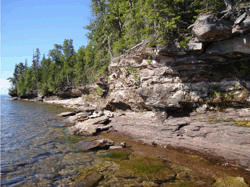
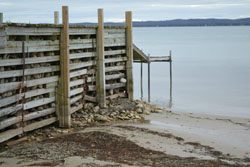
Water levels have hit record lows on Lakes Michigan and Huron. Northport Bay on November 4, 2012. (Photo by Clare Brush)
Lake Michigan and Lake Huron have hit record low water levels…
This is the Environment Report. I’m Rebecca Williams.
The U.S. Army Corps of Engineers has been recording water levels for almost 100 years. In January, the levels in the Lake Michigan and Huron system dipped to the lowest level ever recorded.
That’s causing problems for commercial shipping and recreational boaters.
Peter Payette has been covering this story and he joins me now.
Peter, how big of a deal are these low lake levels?
Payette: Well, they’re getting to be quite a problem in various places in a number of ways. The issue that’s front and center this week has to do with the harbors and the need for dredging the channels in and out of harbors. For a few years now, smaller harbors especially have not been getting the help they’re accustomed to from the federal government. Traditionally, it’s been the federal government through the U.S. Army Corps of Engineers that has dredged these channels to keep them open, and that has not been happening, and so now with the lake levels lower that problem is really being exacerbated.
RW: What options do the coastal communities have?
Payette: Well, they’ve just been scraping together what money they can to get by, and it’s a struggle, it’s expensive. Leland – people may be familiar with the harbor there, with historic Fishtown – last year, they spent more than $100,000 to dredge the channel in and out of the harbor, but that wasn’t enough to pay to dredge the mouth where sand builds up out in the open water. You need bigger equipment there, and it’s a little dicier to do that kind of work. So, there was what they call a speed bump on the way in, where it was shallower. And then that got even shallower this fall. And on a couple of occasions, the Mishe-Mokwa, the boat that is operated by the Manitou Island Transit Company, takes people out to Manitou Island, it got stuck.
RW: With all these harbors that need dredging, there’s been quite a bit of debate about how to pay for this. What have you found out there?
Payette: Well, the thing that interested me the most was that very soon after the Governor said something needed to be done, some lawmakers came forward and proposed legislation to allow the Natural Resources Trust Fund to be tapped for this purpose. The trust fund is a pool of money generated from oil and gas revenues in Michigan, and it’s mainly used for land preservation. And its uses are regulated by the state Constitution and that’s because in the past, voters objected to proposals to use the money for other things, proposals that legislators have come up with.
So, it’s kind of a political hot potato. But if you talk to conservationists, they’ll point out that the trust fund is a unique fund, and that those dollars, when you sell oil and gas rights and take that money, you only get to sell the oil and gas once so it’s a one-time thing, and that the money should be used for something special.
Here’s how Tom Bailey at the Little Traverse Conservancy put it.
“Because this money flowed from non-renewable resources it should be used for capital improvements and lasting recreational land and improvements that would benefit the people of the state of Michigan for the long term.”
Governor Snyder has his own idea. He’s expected this week to ask the State Waterways Commission to allow some funds the commission controls to be used for dredging. Those are funds that are usually given out in the form of grants to harbor communities to improve harbors, to add a marina on, or build a new facility, extend a dock, things like that. The governor is supposed to ask the commission to allow that money to be used for dredging this year.
Peter Payette has been covering the record low water levels in lakes Michigan and Huron for Interlochen Public Radio. That’s the Environment Report. I’m Rebecca Williams.
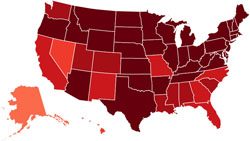
A map the Johns Hopkins' team made using their Twitter method shows that the U.S. experienced a high flu rate the first week of January 2013, which the team says tracks well with CDC data. (Image by Michael Paul/Johns Hopkins University)
Flu season started early and came in swinging. Health officials say it’s been a moderate to severe flu season for most of the country.
Curtis Allen is a spokesman with the Centers for Disease Control and Prevention.
“In Michigan, it’s still at a high level of activity. Hopefully you’ll see less and less as we go on. But influenza is notoriously unpredictable and there could also be another peak,” Allen says.
He says a strain of influenza virus called H3N2 has been circulating this year.
“The H3N2 strain tends to lead to more severe seasons and a greater number of illnesses and hospitalizations and deaths among those who are 65 or older and those who have underlying health conditions.”
Allen says the CDC still recommends getting a flu shot this season if you haven’t yet.
Ugh… I feel terrible today.
It seems like every day somebody’s complaining about being sick on Facebook or Twitter.
It turns out that tweeting that you’re sick with the flu can be actually be useful for science.
Mark Dredze is an assistant research professor in the Department of Computer Science at Johns Hopkins University. He’s designed a method of tracking flu cases using Twitter.
I asked him how he can tell who’s really sick with the flu and who’s just talking about some celebrity getting the flu.
“In order to figure out if someone’s really sick, you need to go beyond just looking at what words they happen to use, like ‘flu’ or ‘sick’ and use a deeper level analysis of what they’re saying to figure out if they’re saying ‘I am sick’ or ‘I’m worried about getting sick’ or ‘I hope I don’t get sick.’ And what we’ve done here is we’ve developed some new algorithms that can do exactly that. They go beyond just the shallow words and try and get the real meaning of what the person’s trying to say.”
He says Twitter is a great resource for tracking illness because it’s publicly available.
“The Centers for Disease Control and Prevention do a very good job of putting together what the flu rate is in the United States, but they do it on a fairly broad level and it takes them a while to do that. It takes about two weeks for the CDC to put out today’s flu rate. So, that’s a little bit slow for making critical decisions about how to respond to flu epidemics, much like we’re seeing this year. It would be much more valuable if we could have up to the day or up to the minute estimates of what the flu rate is, so we could respond much more quickly as epidemics arise, with the critical pieces of information.”
I asked him how closely his Twitter method tracks with the CDC’s data.
“So we looked at this for the current flu season, and it’s still early because we’re in the middle of that flu season, but it seems our new method tracks much more closely with CDC data than previous methods for doing things with Twitter.”
But there aren’t a lot of elderly people or really young kids tweeting – and Dredze acknowledges that’s a limitation of tracking diseases with tweets.
“The demographics of Twitter are really key here. Certainly if we were interested in studying the elderly population, Twitter would be a very bad resource. Beyond that, Twitter is actually a very good resource for studying the population, at least in the United States, as it’s really become an incredibly popular tool. Right now, Twitter has about a half a billion tweets a day, and while many of those are from outside the United States, the U.S. makes up a significant percentage of that data. So, we really have a lot of people in the United States using this, which makes it great. Tracking the flu is really just the tip of the iceberg here. There’s a lot more data here, and a lot more interesting applications, and I think we’re going to start to see those emerge in the next couple of years.”
He talked specifically about our current energy policy. There are a couple big things in there. One is our renewable portfolio standard. Utilities have to get 10 percent of their retail sales from renewable sources by the year 2015. And there’s also an energy efficiency goal utilities have to meet.
“My belief is we need to increase the goals but let’s spend the next year, let’s spend 2013, having an open dialogue with all the participants, understanding where we’re at… how well we’ve done, and we’ve done well on some of these things.”
But state officials don’t want these forums to be a wrestling match with a lot of shouting. You might think of them more like helping the government do its homework.
Steve Bakkal directs the Michigan Energy Office.
“Sure, will there be groups out there that will come and try to advance their interests? But what we’re asking for is not that specific policy recommendation. We’re asking for the facts that they base their policy recommendations on.”
In other words… the state wants your data.
If you go to the website they’ve set up for this purpose, you’ll find a dizzying set of 100 questions on all things energy.
Many of them are really technical… for example: brace yourself… “What has been Michigan’s experience with self-implementation of rates?”
Not exactly casual water cooler chat.
But Steve Bakkal says the point of all this is to throw a wide net and get some solid facts. Then, Governor Snyder will make recommendations to lawmakers at the end of this year.
The big elephant in the room is whether we should move away from using so much coal, and use more wind, solar and other renewables.
Governor Snyder thinks utilities should be required to get more energy from renewable sources.
Michigan’s two biggest utilities both stop short of saying yes or no to that idea.
Alejandro Bodipo-Memba is a spokesman for DTE Energy.
“It’s still a little too early to say whether it should or shouldn’t from our perspective in that we’re still trying to reach the 10 percent goal by 2015. But certainly, and we’ve said this from the beginning, that once we reach that threshold and assuming we’re on all cylinders to reach that, we are more than open to talk about next steps and I think that that’s kind of the tone the governor was taking with regard to that.”
HOLYFIELD: “Our position is that the process established by the governor should be allowed to proceed and move forward.”
That’s Jeff Holyfield with Consumers Energy.
“And then any decision about the renewable energy standard can be based on good hard facts and then there can be a discussion about ‘well, what is appropriate?'”
Others argue we shouldn’t spend too much time talking.
James Clift is the policy director for the Michigan Environmental Council. He says it makes sense to continue slowly raising our renewable standard.
“There’s a lot of businesses that have been created over the last five years in Michigan in this new field, and if we wait too long there will be a gap where we’ll go a year or two without building anything, unfortunately I think that would result in the layoff of Michigan workers.”
Bill Arnold and a student collecting sediment samples. (Photo courtesy: University of Minnesota)
When you use anti-bacterial soap, there’s a good chance there’s an ingredient called triclosan in it. It’s also added to things like body washes, some toothpastes, and dishwashing soap. You can find it listed as an ingredient on the label for many of those products.
But the Food and Drug Administration says there’s no evidence that using soap with triclosan in your home or office is any better at keeping you from getting sick than regular soap and water. (Health experts say a good rule of thumb is to wash your hands with soap and water for 20 seconds: the length of time it takes to sing the “happy birthday” song twice.)
The FDA says triclosan is not known to be hazardous to humans. But the agency is re-evaluating the safety of triclosan in light of animal studies showing the chemical alters hormone regulation… and also because of studies suggesting that triclosan contributes to making bacteria resistant to antibiotics.
A new study in the journal Environmental Science and Technology finds triclosan is showing up in freshwater lakes, including Lake Superior.
Bill Arnold is a professor of civil engineering at the University of Minnesota and an author of the study, and he joins me now. Professor Arnold, you and your team took core samples from the sediment of eight lakes of different sizes in Minnesota. What’d you find?
Arnold: “We found that in all the lakes there’s triclosan in the sediment, and in general, the concentration increased from when triclosan was invented in 1964 to present day. And we also found there are seven other compounds that are derivatives or degradation products of triclosan that are also in the sediment and also increasing in concentration with time.”
RW: How are these compounds getting into the lakes?
Arnold: “So triclosan goes through the wastewater treatment system, and the wastewater treatment plant actually does a pretty darn good job of removing it. 90 to 95 percent of it is taken out, but we use so much triclosan that the rest of it gets through, and three of the compounds we found are chlorinated triclosan derivatives, and they’re formed in the last step of wastewater treatment, when the wastewater is disinfected before it’s discharged and the disinfectant is chlorine. So that creates these three new compounds. And then triclosan and these three new compounds, when they’re exposed to sunlight, each of them undergoes a reaction that forms a dioxin, so that’s where the other four compounds come from.
RW: Are these at levels that could be of concern?
Arnold: “The triclosan appears to be approaching levels that could be of concern, because it’s known to be toxic to algae. So – we didn’t look at the levels in the water, but in the sediment, but in some cases they’re rather high in the sediment. For the other compounds we’re not sure, because the toxicity of them really hasn’t been studied.
RW: The trade group for the cleaning products industry continues to maintain the safety of triclosan. But at the same time… both the FDA and the Environmental Protection Agency are re-evaluating the effects of triclosan on human health and the environment… at this point, from your perspective, what’s the bottom line here for consumers?
Arnold: “I think this is a case where consumers can certainly put pressure on the market. So if consumers look at their products and don’t buy things with triclosan, they’re making their voice heard. Or they can also talk to the retailers and the manufacturers and tell them they don’t want this product if that’s the choice they make, if they don’t like the fact that it’s going beyond their sink and into the environment.”
RW: Do you think that we know enough yet to evaluate whether it’s hazardous – either to human health or to other organisms?
Arnold: “I don’t think we know quite enough yet. The toxicologists need to get involved and look at the full suite of compounds that are formed and then the human health people need to do their thing as well. I’m not qualified to do either of those. That said, Canada has decided they’ve got enough information and last year, deemed it toxic to the environment.”
Bill Arnold is a professor of civil engineering at the University of Minnesota.
That’s the Environment Report. I’m Rebecca Williams.